
Nearly three decades after rage first flooded Britain’s streets, 28 Years Later: The Bone Temple arrives not as a nostalgia exercise, but as a grim meditation on what survival does to civilization when time outlasts hope. Directed by Danny Boyle, the film strips the infected genre back to its bones, sometimes literally, and rebuilds it as something colder, quieter, and far more unsettling.
Plot (Light Spoilers)
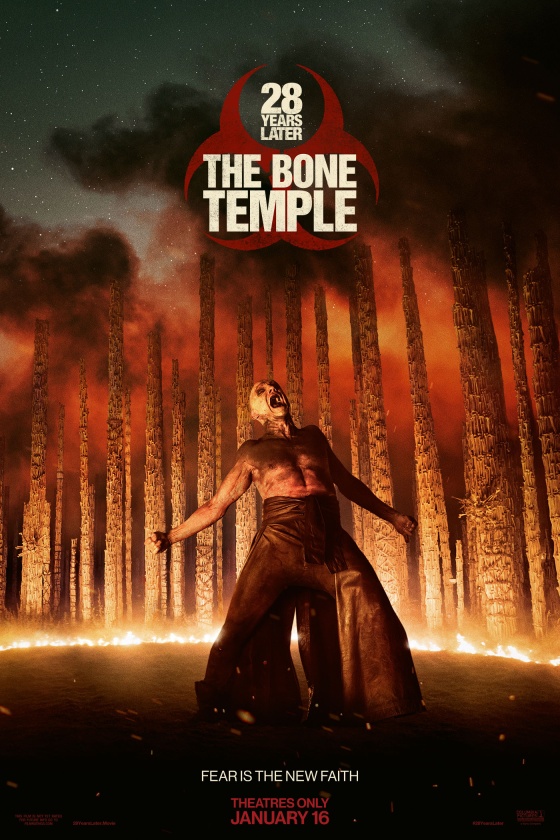
The world has not healed. It has adapted. Human settlements exist like nervous scars across a decayed landscape, while the infected, fewer in number but no less terrifying, have become part of the ecosystem. At the center is the Bone Temple, a grotesque structure made from human remains, functioning as both sanctuary and warning. The story follows a small group of survivors drawn toward this place for different reasons: belief, desperation, and the dangerous need for meaning.
The plot moves deliberately, often withholding information rather than explaining it. This restraint works in the film’s favor, creating dread not through constant violence, but through implication.
Direction and Atmosphere
Danny Boyle’s direction feels more restrained than 28 Days Later, yet more mature. Gone is the jittery panic of sudden collapse; in its place is the suffocating weight of a world that simply refuses to end. The camera lingers on empty spaces, decayed churches, and silent roads, suggesting that horror now lives in absence rather than chaos.
The Bone Temple itself is the film’s most powerful symbol, less a horror prop and more a philosophical statement. It represents humanity’s urge to mythologize trauma, to turn suffering into structure.
Performances
The cast delivers performances that are intentionally muted. Fear here is not screamed; it is carried. One standout is Cillian Murphy, returning in a limited but emotionally heavy role, whose presence bridges the franchise’s past and present. His performance reinforces the film’s central idea: survival is not the same as living.
Supporting characters are written with moral ambiguity. No one is fully heroic, and no one is purely monstrous. Even belief systems formed after the outbreak feel understandable, if deeply disturbing.
Themes: Faith, Memory, and Rot
Unlike many post-apocalyptic films that focus on rebuilding, The Bone Temple asks whether rebuilding is even desirable. Religion, ritual, and symbolism emerge not as comfort, but as coping mechanisms that may be just as dangerous as the virus itself.
The film subtly critiques how societies rewrite history to survive it. The infected are no longer just enemies; they are reminders of what humanity chose to preserve, and what it abandoned.
Technical Craft
The sound design deserves special mention. Silence is weaponized. When music appears, it is sparse and haunting, echoing the original film’s iconic minimalism without repeating it. Practical effects dominate, giving the infected a disturbing physicality that CGI would have diluted.
The cinematography favors natural light and decay-heavy color palettes, ashen grays, sickly greens, and bone-white highlights, creating a visual language that feels both ancient and post-modern.
Final Verdict
28 Years Later: The Bone Temple is not a crowd-pleasing horror sequel. It is slower, darker, and more contemplative than many will expect. But for viewers willing to engage with its ideas, it stands as one of the most thoughtful entries in modern post-apocalyptic cinema.
This is a film about what happens after survival, when the world no longer ends, but refuses to forgive.
28 Years Later: The Bone Temple Movie Review
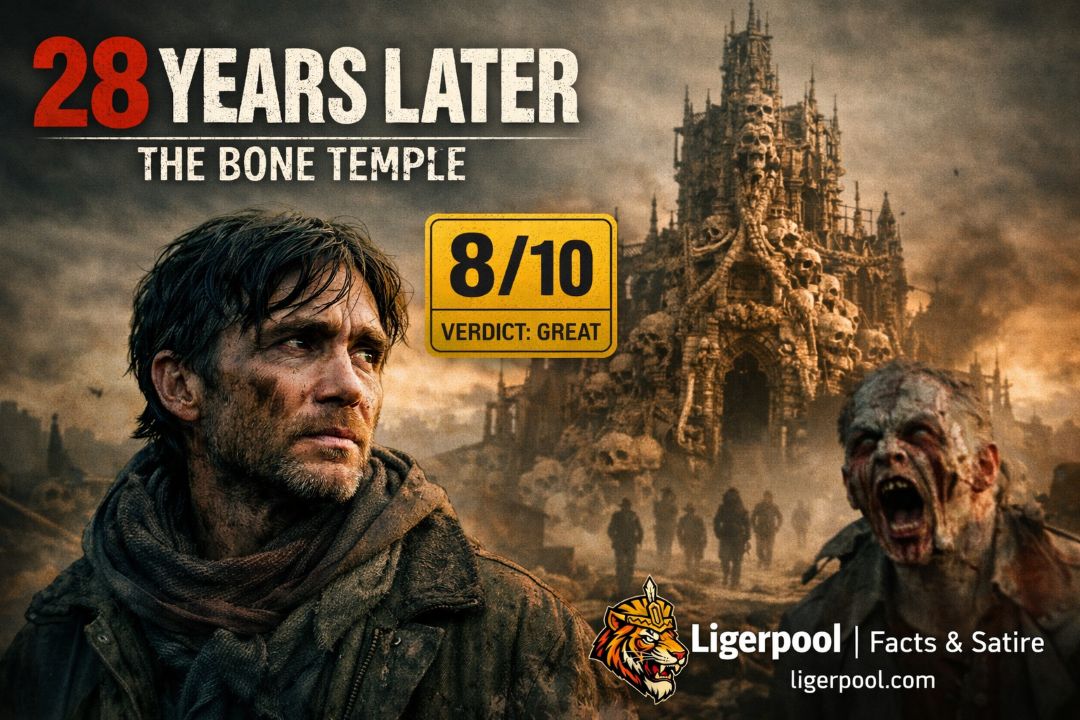
8/10
Great


